Complete Electronic Cleaning Guide by JustYou
In modern electronic manufacturing, PCBA cleaning is an essential process after soldering. Residues such as:
- Flux
- Solder dross
- Dust
- Ionic contaminants
- Oil stains
can negatively affect the reliability, electrical performance, and long-term stability of electronic products.
As electronic assemblies become increasingly compact and high-density, selecting the correct PCBA cleaning solution has become more important than ever.
At JustYou, we specialize in advanced SMT materials and electronic manufacturing process solutions. This article introduces the most common PCBA cleaning methods used in the electronics industry and explains their advantages, limitations, and application scenarios.
Why Is PCBA Cleaning Important?
After reflow soldering or wave soldering, contaminants remain on the PCB surface and around solder joints.
If these residues are not properly removed, they may cause:
- Electrical leakage
- Corrosion
- Signal instability
- Short circuits
- Reduced insulation resistance
- Poor product reliability
Proper PCBA cleaning helps improve:
- Product lifespan
- Thermal performance
- Electrical stability
- Cosmetic appearance
- Reliability in harsh environments
For industries such as automotive electronics, aerospace, medical devices, and communication equipment, high-quality cleaning is especially critical.
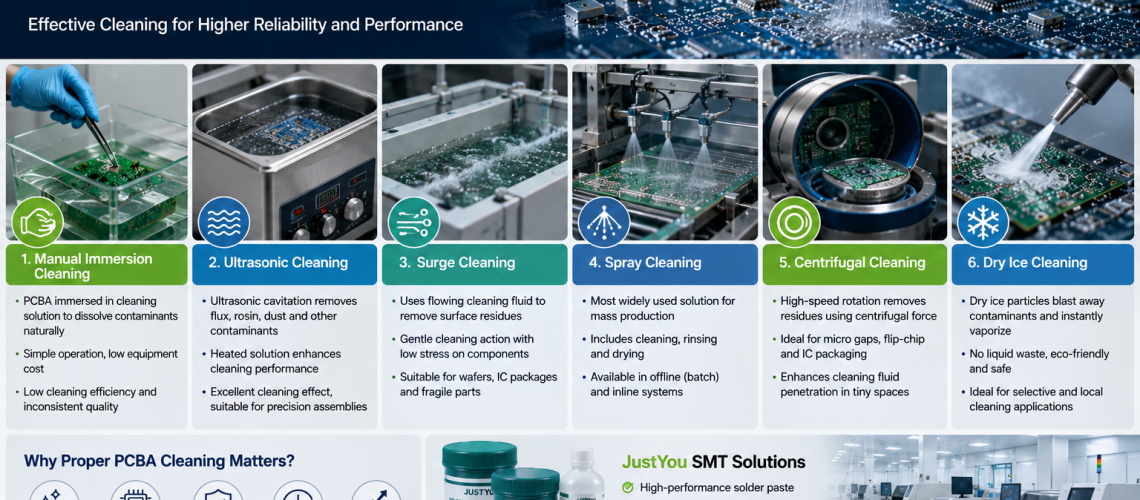
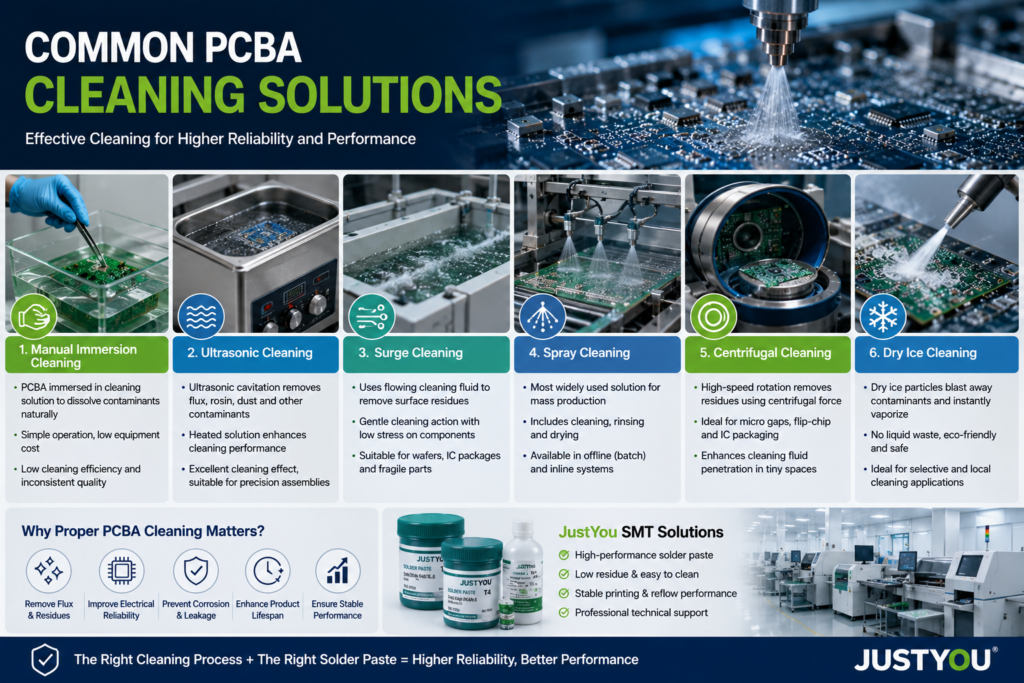
1. Manual Immersion Cleaning
Manual immersion cleaning is one of the most traditional cleaning methods.
How It Works
The PCBA is immersed in a cleaning solution where contaminants naturally dissolve or detach from the board surface.
This method is simple and low-cost.
Advantages of Manual Immersion Cleaning
- Simple operation
- Low equipment cost
- Suitable for small-scale production
- Easy for prototype testing
Limitations
However, manual immersion cleaning also has several disadvantages:
- Low cleaning efficiency
- Poor consistency
- Difficult to control ionic contamination levels
- Not suitable for high-density PCB assemblies
Because cleaning relies heavily on manual operation, quality stability may vary significantly.
At JustYou, we recommend this method mainly for small-batch or non-critical applications.
2. Ultrasonic Cleaning
Ultrasonic cleaning is one of the most widely used precision cleaning technologies in electronic manufacturing.
How Ultrasonic Cleaning Works
The PCBA is placed inside a cleaning solution while ultrasonic waves generate microscopic cavitation bubbles.
These bubbles continuously collapse and create strong cleaning energy that removes:
- Flux residues
- Rosin
- Fine dust
- Surface contamination
The cleaning solution is usually heated to improve dissolving performance.
Advantages of Ultrasonic Cleaning
JustYou recommends ultrasonic cleaning for precision applications because it offers:
- Excellent cleaning performance
- Strong penetration capability
- Effective removal of fine contaminants
- Good cleaning consistency
It is particularly effective for:
- Small electronic assemblies
- Precision components
- Semiconductor packaging
Limitations
Despite its advantages, ultrasonic cleaning may not be suitable for all products.
Potential concerns include:
- Risk of damage to fragile components
- Cavitation stress on sensitive devices
- Limited suitability for large heavy PCB assemblies
Careful frequency and power control are required.
3. Surge Cleaning
Surge cleaning uses water-based cleaning agents combined with fluid flow movement.
Working Principle
The PCBA is immersed in flowing cleaning liquid, and the moving water removes surface contaminants.
Compared with spray cleaning, surge cleaning uses gentler physical force.
Advantages of Surge Cleaning
- Mild cleaning action
- Reduced mechanical stress
- Suitable for delicate components
- Lower risk of component damage
This method is commonly used in:
- Wafer cleaning
- IC packaging processes
- Fragile semiconductor devices
Limitations
Surge cleaning has relatively weak cleaning force.
Therefore, it is less suitable for:
- Heavy flux residues
- Large PCB assemblies
- High-volume PCBA cleaning
JustYou recommends surge cleaning mainly for semiconductor and microelectronic applications.
4. Spray Cleaning
Spray cleaning is currently the most widely used PCBA cleaning solution for mass production.
How Spray Cleaning Works
Heated cleaning solution is sprayed onto the PCBA surface under controlled pressure to remove contaminants.
The process typically includes:
- Cleaning
- Rinsing
- Drying
Types of Spray Cleaning Equipment
Offline Spray Cleaning (Batch Cleaning)
In batch cleaning systems:
- PCBAs are loaded in batches
- Cleaning solution is heated and sprayed
- DI water rinses the assemblies
- Drying completes the process
This equipment provides a complete cleaning cycle.
Inline Spray Cleaning
Inline systems are designed for:
- Fully automated production
- High-volume manufacturing
- Continuous SMT production lines
Inline spray cleaning offers:
- High efficiency
- Stable process control
- Reduced labor costs
- Excellent repeatability
At JustYou, we recommend spray cleaning for large-scale SMT manufacturing environments.
Advantages of Spray Cleaning
- High production efficiency
- Excellent cleaning consistency
- Suitable for automation
- Strong cleaning capability
5. Centrifugal Cleaning
Centrifugal cleaning uses high-speed rotation to remove contaminants from PCB surfaces.
How It Works
The PCBA is placed inside a rotating cleaning chamber while cleaning solution is sprayed onto the assembly.
High-speed centrifugal force helps remove:
- Fine residues
- Flux contamination
- Micro-gap impurities
Advantages of Centrifugal Cleaning
This method is especially useful for:
- Ultra-small gaps
- Flip-chip packaging
- IC packaging
- Wafer cleaning
Centrifugal force improves cleaning fluid penetration into extremely small spaces that are difficult to access using conventional methods.
Applications in Advanced Packaging
Centrifugal cleaning is commonly used for:
- Flip-chip packaging
- Bottom-fill pre-treatment
- Semiconductor bump cleaning
- Microelectronic assembly
As packaging density increases, this cleaning method becomes increasingly important.
6. Dry Ice Cleaning
Dry ice cleaning is an environmentally friendly cleaning technology developed in recent years.
How Dry Ice Cleaning Works
Compressed air accelerates dry ice particles toward the PCBA surface.
The dry ice particles:
- Strike contaminants
- Cause residue separation
- Vaporize immediately after impact
This leaves no liquid waste behind.
Advantages of Dry Ice Cleaning
JustYou recognizes dry ice cleaning as an advanced eco-friendly solution because it provides:
- No liquid waste generation
- No secondary contamination
- No moisture residue
- Safe localized cleaning
- Environmentally friendly operation
It is especially useful for partial cleaning applications where surrounding components must remain protected.
Limitations of Traditional Liquid Cleaning
Traditional solvent cleaning methods often face challenges such as:
- Waste liquid disposal
- Environmental compliance
- Difficult local cleaning control
- Residual moisture risks
Dry ice cleaning effectively addresses many of these problems.
Choosing the Right PCBA Cleaning Solution
Different cleaning methods suit different manufacturing requirements.
Key Factors to Consider
When selecting a cleaning process, manufacturers should evaluate:
- PCB complexity
- Component sensitivity
- Production volume
- Flux type
- Environmental regulations
- Reliability requirements
- Cost considerations
At JustYou, we help customers select optimized cleaning solutions based on their specific SMT production needs.
The Relationship Between Solder Paste and Cleaning
Solder paste formulation directly influences cleaning difficulty.
Poor-quality solder paste may produce:
- Excessive residue
- High ionic contamination
- Difficult-to-remove flux
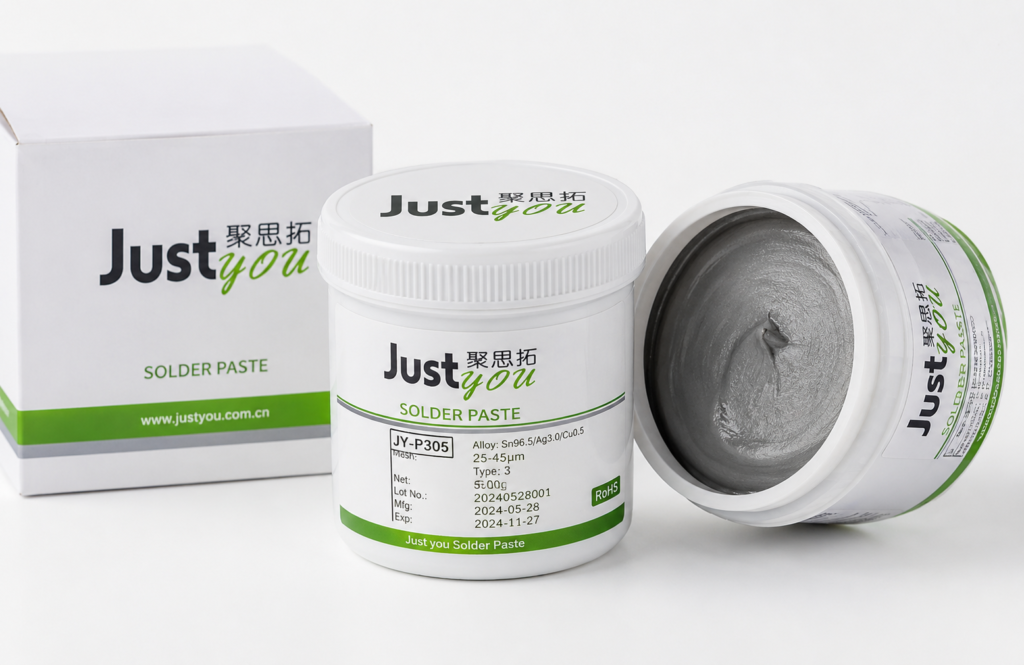
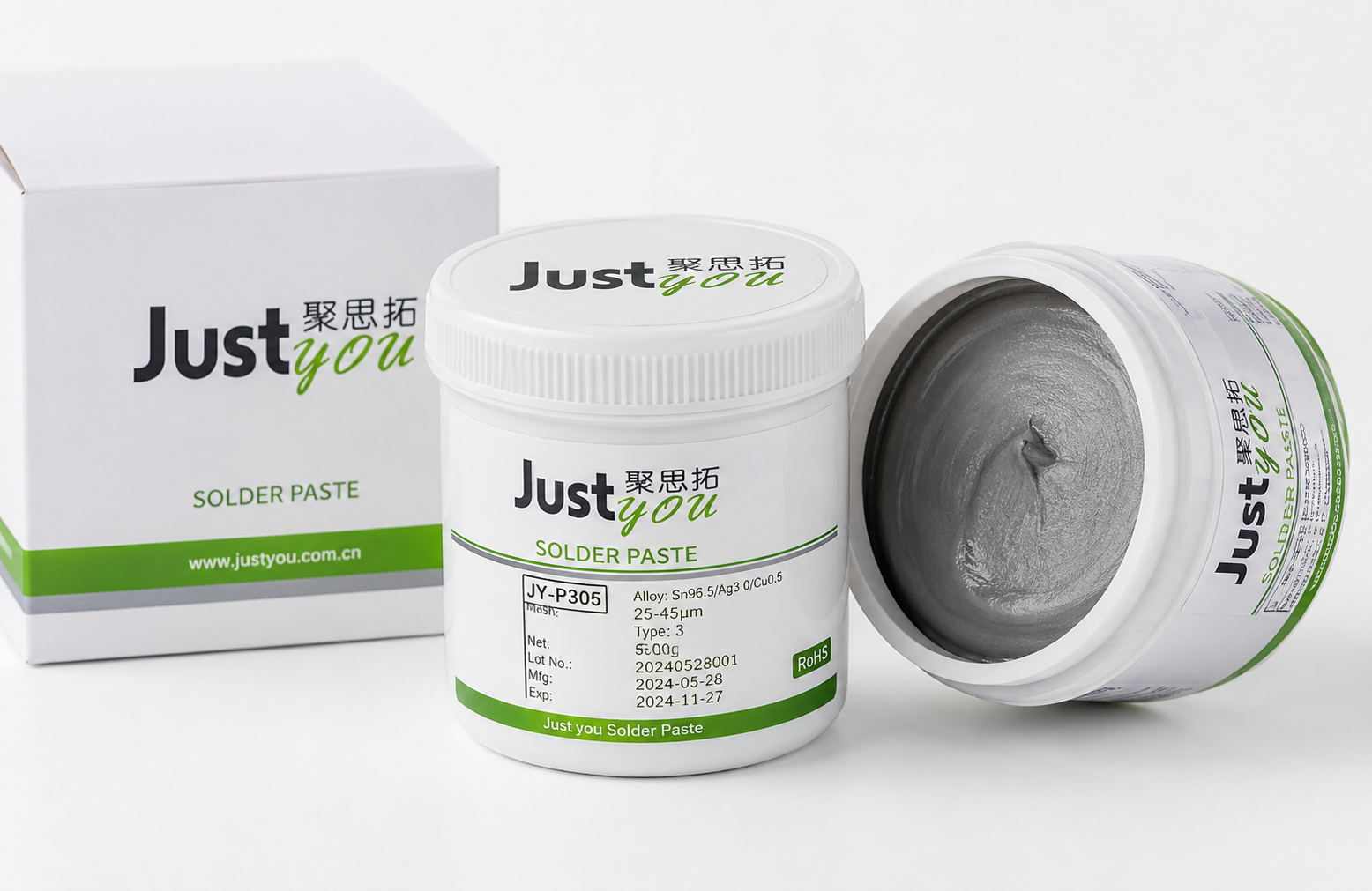
JustYou solder paste products are engineered for:
- Low residue
- Excellent solderability
- Stable reflow performance
- Improved cleanability
This helps simplify post-solder cleaning processes and improve overall manufacturing efficiency.
Future Trends in PCBA Cleaning Technology
As electronic assemblies continue moving toward:
- Smaller packages
- Higher density
- Fine-pitch SMT
- Semiconductor integration
cleaning technologies are evolving rapidly.
Future trends include:
- Automated intelligent cleaning systems
- AI-driven process monitoring
- Eco-friendly cleaning agents
- Ultra-low residue solder materials
- Advanced dry cleaning technologies
JustYou continues investing in next-generation SMT process solutions to support advanced electronic manufacturing industries worldwide.
Why Choose JustYou SMT Solutions?
JustYou provides professional electronic soldering materials and SMT manufacturing support for global customers.
Our Advantages
- High-performance solder paste
- Low-residue formulations
- Professional SMT process support
- Advanced cleaning compatibility
- OEM & ODM services
- Stable product quality
- Global export experience
Our products are widely used in:
- Consumer electronics
- Automotive electronics
- Semiconductor packaging
- Communication equipment
- Industrial automation
- Mini LED manufacturing
Conclusion
PCBA cleaning is a critical step in ensuring electronic product reliability and long-term performance.
Different cleaning methods — including:
- Manual immersion cleaning
- Ultrasonic cleaning
- Surge cleaning
- Spray cleaning
- Centrifugal cleaning
- Dry ice cleaning
all offer unique advantages for specific applications.
By selecting the appropriate cleaning technology and using high-quality SMT materials, manufacturers can significantly improve production quality and operational reliability.
JustYou remains committed to providing advanced solder paste materials and professional SMT process solutions for modern electronic manufacturing industries.