Beyond the Label: Do You Really Need to Clean “No-Clean” Flux?
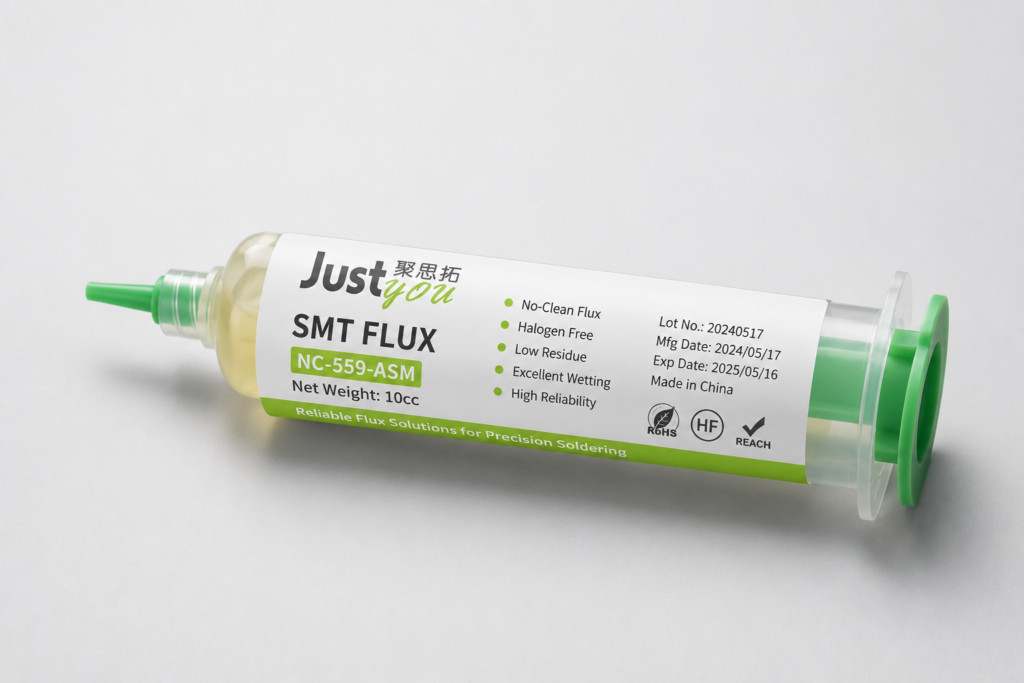
In the intricate process of soldering, flux is the unsung hero. By removing stubborn oxides and enhancing wettability, it ensures the structural integrity and reliability of every solder joint. While flux is traditionally categorized by chemistry, the industry standard has shifted toward the convenience of “no-clean” flux.
But here is the critical question often overlooked: Does “no-clean” actually mean “zero residue”? At Justyou, we believe in empowering our partners with the technical clarity needed to make the right decision for their specific applications.
The Reality of No-Clean Flux
No-clean flux is engineered to leave behind minimal, non-conductive, and non-corrosive residues, allowing manufacturers to skip the post-soldering cleaning stage to save time, reduce costs, and minimize environmental impact.
However, “no-clean” does not imply the residues are magically absent. These residues—containing traces of organic acids, halogens, and metal ions—remain on the board. While they are stable under ideal conditions, they are not inherently harmless. Under specific stressors, these chemical traces can become reactive, leading to long-term issues like corrosion, surface insulation resistance (SIR) degradation, or even catastrophic electrical leakage.
When Cleaning Becomes Mandatory
While your board might pass initial inspection without cleaning, the true test is its operational environment. Justyou recommends considering a post-soldering cleaning process if your product falls into these categories:
- Harsh Environments: If your electronics are destined for high-temperature, high-humidity, or salt-mist environments, residual flux can absorb moisture, accelerating corrosion and dendrite growth.
- High-Performance Applications: In high-frequency, high-speed, or high-voltage circuits, even microscopic residues can alter impedance or create parasitic capacitance, interfering with critical signal integrity.
- Mission-Critical Reliability: For medical devices, aerospace hardware, or products requiring an exceptionally long service life, removing all chemical residues is a necessary insurance policy against future failures.
Selecting Your Cleaning Strategy
If your application demands a pristine board, Justyou recommends selecting a cleaning method that matches your board’s complexity and budget:
- Water Cleaning: Utilizing deionized or purified water. It is the most cost-effective and eco-friendly choice, though it may leave mineral scale if water quality is not strictly controlled.
- Solvent Cleaning: Ideal for stubborn residues. High-performance solvents dissolve contaminants efficiently, providing a thorough clean, though they require careful handling and ventilation.
- Ultrasonic Cleaning: The gold standard for precision. By combining chemical action with mechanical vibration, this method ensures deep penetration into tight pitches and underneath components—perfect for complex BGA or high-density layouts.
The Justyou Commitment
At Justyou, we understand that there is no “one-size-fits-all” flux. Our extensive portfolio includes:
- Diverse Chemistries: From no-wash to water-wash, and rosin-based to high-performance epoxy resin formulations.
- Tailored Solutions: We don’t just sell products; we partner with you to ensure your flux selection aligns perfectly with your cleaning capabilities and end-use reliability requirements.
Don’t let residual flux become a hidden liability in your supply chain. Whether you need a low-residue solution that truly lives up to its name or a high-activity flux for a more robust cleaning process, Justyou is here to support your success.
Are you evaluating your current flux performance? Contact our technical team today to discuss how Justyou can optimize your soldering process.