Advanced TLP Bonding Reliability Guide by JustYou
In modern power electronics and semiconductor packaging, solder joint reliability plays a critical role in overall device performance. One of the most common challenges during transient liquid phase (TLP) bonding is the formation of voids inside solder joints.
Voids can significantly reduce:
- Thermal conductivity
- Mechanical strength
- Electrical reliability
- Long-term product lifespan
At JustYou, we specialize in advanced solder paste materials and SMT process optimization solutions for high-reliability electronic manufacturing. This article explores the major causes of void formation during soldering and the effective methods used to reduce void-related defects.
What Is Transient Liquid Phase (TLP) Bonding?
Transient Liquid Phase bonding is an advanced soldering technology widely used in:
- Power device packaging
- Semiconductor modules
- Automotive electronics
- High-temperature electronic assemblies
- High-power LED systems
TLP bonding uses:
- Low melting point metals as intermediate layers
- High melting point metals on substrates
During bonding, the low-temperature solder melts and reacts with the substrate materials to form stable intermetallic compounds (IMCs).
The major advantage of TLP bonding is that:
- Bonding occurs at lower temperatures
- Final joints remain stable at higher operating temperatures
However, TLP soldering is highly sensitive to void formation.
Why Are Voids Dangerous in Solder Joints?
Voids are trapped empty spaces or cavities formed inside solder joints during the bonding process.
Excessive voids may cause:
- Poor heat dissipation
- Increased thermal resistance
- Reduced mechanical integrity
- Solder joint cracking
- Device overheating
- Premature product failure
For high-power electronic applications, minimizing void formation is essential for long-term reliability.
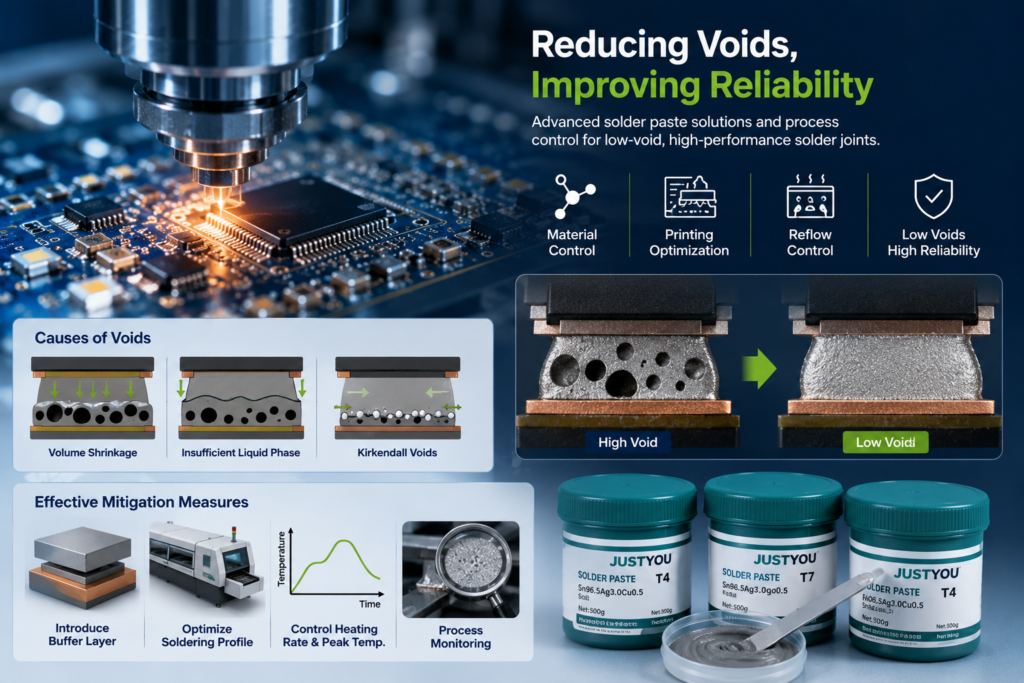
1. Main Causes of Voids During Soldering
1.1 Volume Shrinkage During IMC Formation
One of the most common causes of void formation in TLP systems is volume shrinkage.
How It Happens
During soldering:
- Intermetallic compounds (IMCs) begin to form
- The density and crystal structure of IMCs differ from the original solder alloy
- The final IMC volume becomes smaller than the total volume of the original reacting metals
As the solder joint shrinks:
- Tensile stress accumulates
- Internal stress increases
- Stress release creates voids inside the solder joint
This phenomenon becomes more severe in high-temperature or long-duration soldering conditions.
1.2 Insufficient Liquid Phase During IMC Formation
Another important cause of voids is the lack of sufficient liquid solder during bonding.
Reaction Limitation Mechanism
In Sn-Cu TLP systems:
- Sn melts during heating
- The molten Sn reacts with Cu substrates
- IMC growth gradually consumes the liquid solder
When the liquid phase becomes insufficient:
- Gaps cannot be fully filled
- Localized shrinkage occurs
- Voids remain trapped inside the solder joint
This issue is especially common in fine-pitch and high-density electronic packaging.
At JustYou, our solder paste formulations are optimized to improve wetting performance and maintain stable liquid-phase behavior during reflow.
1.3 Kirkendall Voids
Kirkendall voids are one of the most studied reliability problems in solder joint metallurgy.
What Causes Kirkendall Voids?
Different metals diffuse at different rates during IMC formation.
In Sn-Cu systems:
- Cu atoms diffuse faster outward
- Uneven diffusion leaves vacancies behind
- Vacancies accumulate and form voids
These voids commonly appear inside the Cu3Sn IMC layer.
Kirkendall voids can seriously weaken:
- Mechanical strength
- Thermal conductivity
- Fatigue resistance
This problem becomes increasingly critical in long-term high-temperature applications.
2. Effective Measures to Reduce Voids
2.1 Introducing a Buffer Layer
One effective method for reducing void formation is adding a metal buffer layer between reaction layers.
How Buffer Layers Work
The additional metal layer forms extra intermetallic compounds that compensate for the consumed liquid solder phase.
For example:
- Using Sn2.4Ag instead of pure Sn
- Promotes Ag3Sn formation
- Reduces void formation inside Ni3Sn4 IMCs
This approach improves:
- Joint density
- Thermal stability
- Mechanical reliability
JustYou provides customized solder paste solutions designed for advanced TLP bonding applications and optimized IMC control.
2.2 Optimizing Soldering Temperature
Temperature control is one of the most critical factors affecting void generation.
Excessively High Temperature
High bonding temperatures accelerate atomic diffusion rates.
As diffusion becomes too rapid:
- More voids are generated
- IMC growth becomes excessive
- Internal stress increases
This is particularly problematic in Cu-based solder systems.
Slow Heating Rate Problems
If the heating rate is too slow:
- The intermediate layer continuously reacts with substrate metals
- The liquid solder may be completely consumed before full melting
- Solder gaps cannot be filled properly
This leaves trapped voids inside the solder joint.
Recommended Reflow Optimization
At JustYou, we recommend:
- Stable heating ramps
- Controlled peak temperatures
- Balanced soaking times
- Optimized cooling rates
These parameters help minimize void formation while maintaining strong solder joint reliability.
3. Importance of Solder Paste Quality
The quality of solder paste directly affects:
- Void rate
- Wettability
- Oxidation resistance
- Flux activity
- Reflow consistency
Poor-quality solder paste may lead to:
- Excessive gas release
- Unstable IMC growth
- Increased residue
- Weak solder joints
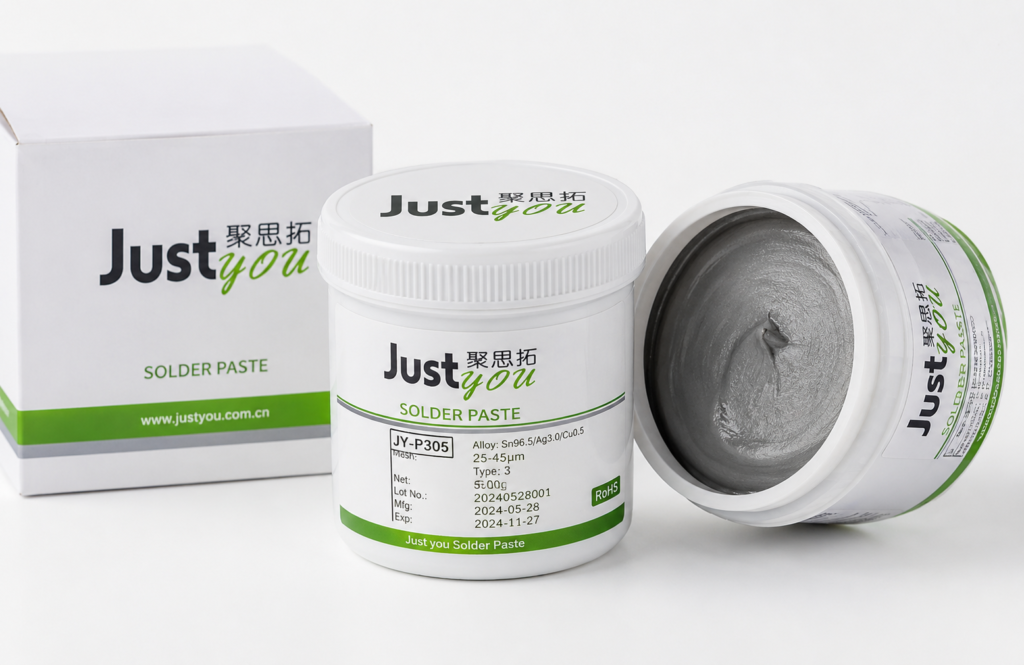
JustYou high-performance solder paste products are designed to provide:
- Low void rates
- Excellent wetting behavior
- Stable printing performance
- Reliable thermal conductivity
- Strong long-term reliability
4. Process Optimization for Low Void Soldering
Vacuum Reflow Technology
Vacuum reflow can effectively remove trapped gases during soldering.
Benefits include:
- Reduced internal porosity
- Improved thermal transfer
- Higher solder joint density
This technology is increasingly used in:
- Power electronics
- Automotive modules
- IGBT packaging
- High-power LED systems
Nitrogen Protection During Reflow
Nitrogen environments help reduce oxidation during soldering.
Advantages include:
- Better wettability
- Reduced flux residue
- Improved solder flow
- Lower void generation
JustYou recommends nitrogen reflow for high-reliability SMT production.
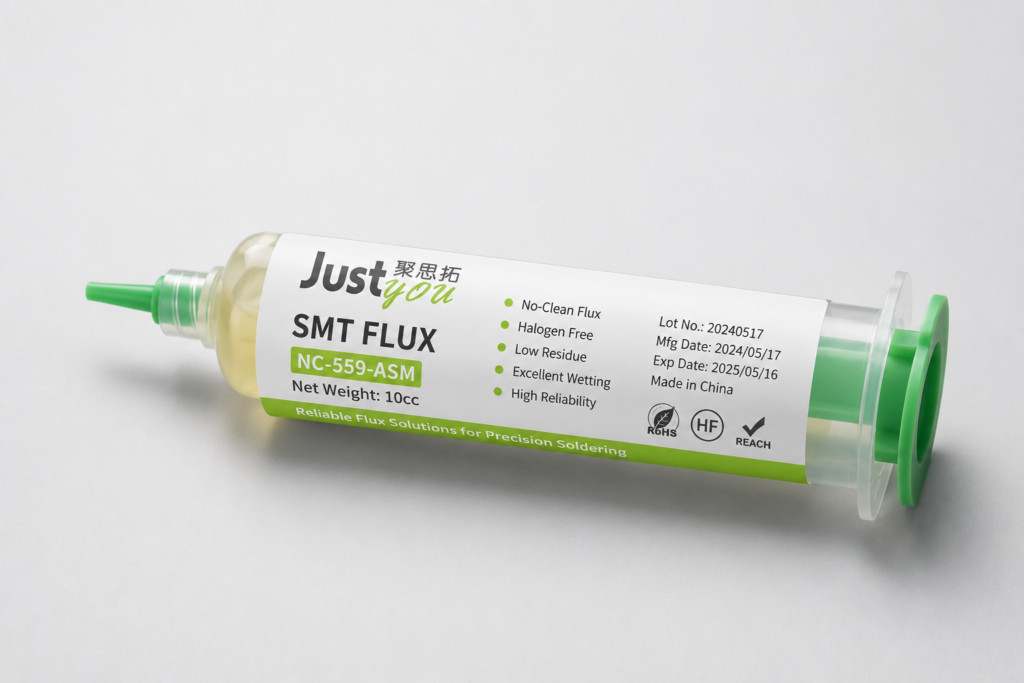
Optimized Flux Formulation
Advanced flux chemistry can improve:
- Outgassing control
- Oxide removal
- Wetting consistency
- Residue management
Our JustYou solder paste products use carefully optimized flux systems for advanced semiconductor and SMT applications.
5. Applications Requiring Low Void Soldering
Low-void solder joints are critical in:
- Power semiconductor modules
- Automotive electronics
- High-power LED packaging
- Mini LED displays
- Aerospace electronics
- Industrial control systems
- Communication equipment
These industries require stable thermal management and long operational lifetimes.
Why Choose JustYou Solder Paste Solutions?
JustYou focuses on advanced electronic soldering materials and SMT process solutions for global manufacturing industries.
Our Advantages
- Advanced solder paste technology
- Low-void formulation design
- Strong R&D capability
- Customized soldering solutions
- Stable product consistency
- OEM & ODM support
- Professional process optimization
We help customers improve:
- Product reliability
- Production yield
- Thermal performance
- Solder joint stability
Future Trends in Low-Void Soldering Technology
As electronic devices become:
- Smaller
- More powerful
- More thermally demanding
the need for ultra-low-void soldering technology continues to grow.
Future developments will focus on:
- Nano-particle solder materials
- Advanced flux chemistry
- Intelligent reflow systems
- AI-driven process optimization
- High-reliability semiconductor packaging
JustYou continues investing in next-generation solder paste technologies to support future electronic manufacturing innovations.
Conclusion
Void formation remains one of the biggest challenges in TLP bonding and advanced soldering applications.
Factors such as:
- Volume shrinkage
- Insufficient liquid phase
- Kirkendall diffusion
- Poor temperature control
can all contribute to solder joint voids.
Through optimized solder paste formulations, advanced reflow control, buffer layer design, and process optimization, manufacturers can significantly reduce void rates and improve overall product reliability.
JustYou remains committed to providing high-performance solder paste materials and advanced SMT process solutions for the global electronics industry.