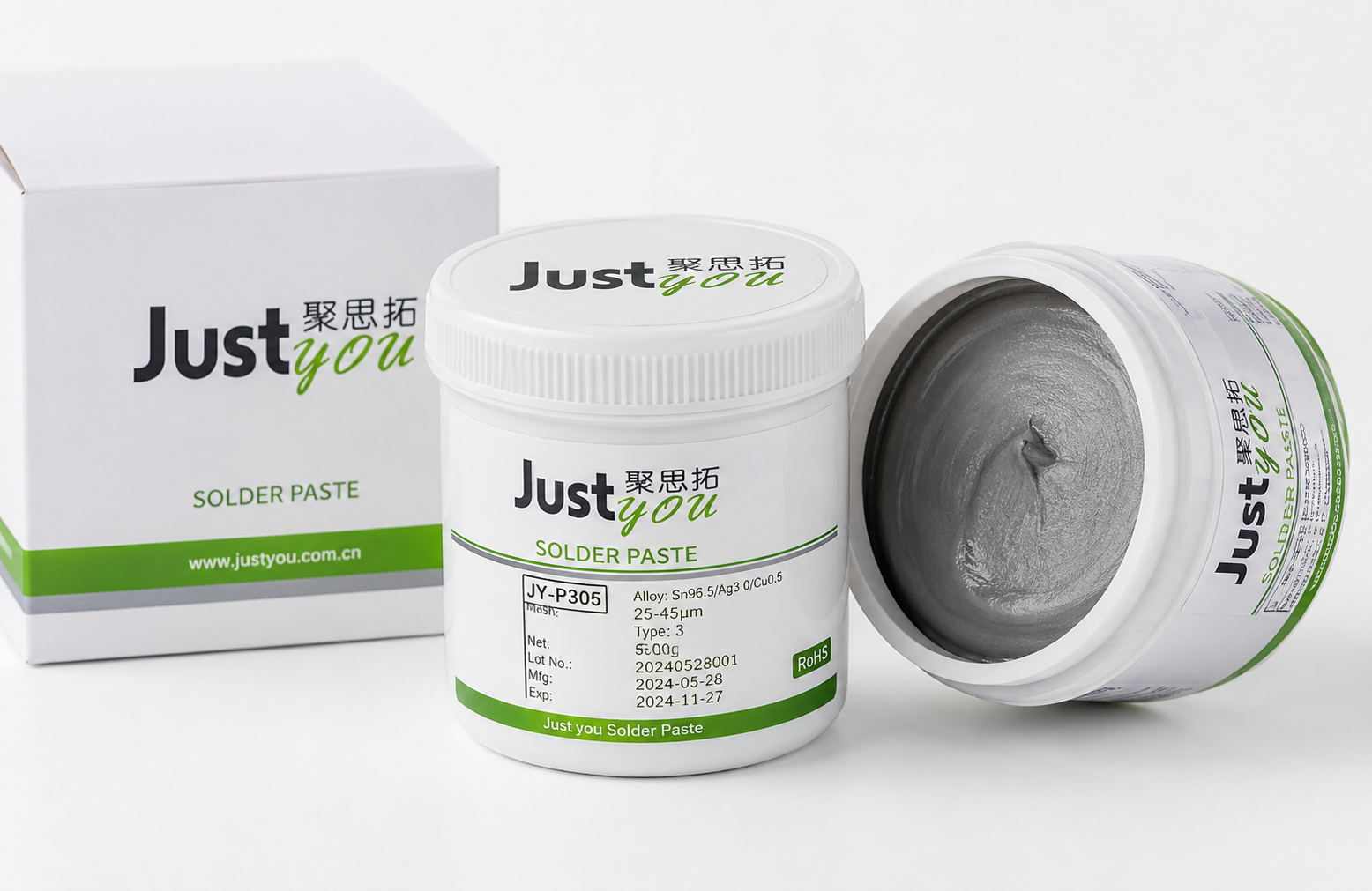

Complete SMT Reliability Guide by JustYou
In modern SMT electronic manufacturing, the “popcorn effect” is one of the most critical reliability challenges affecting PCB assembly and semiconductor packaging.
This phenomenon typically occurs during reflow soldering when moisture trapped inside components or PCB materials rapidly vaporizes under high temperatures, causing internal expansion, cracking, delamination, or even explosive damage to electronic components.
At JustYou, we specialize in high-performance solder paste materials and advanced SMT process solutions. In this article, we explain how professional solder paste process control can effectively reduce the risk of the popcorn effect and improve production reliability.

What Is the Popcorn Effect in SMT Manufacturing?
The popcorn effect refers to the cracking or delamination of moisture-sensitive electronic components during reflow soldering.
When moisture trapped inside packages is suddenly heated:
- Water rapidly vaporizes
- Internal pressure increases
- Component packages expand
- Cracks or delamination occur
This issue is especially common in:
- BGA packages
- QFP components
- CSP devices
- PoP assemblies
- High-density PCB applications
The popcorn effect can lead to:
- Electrical failure
- Solder joint defects
- Internal package damage
- Reduced product lifespan
- Higher production costs
Proper solder paste process control plays a major role in minimizing these risks.
I. Material Pre-Treatment: Eliminating Moisture Risks
1. PCB Baking Management
Moisture-contaminated PCBs must be thoroughly baked before soldering.
Recommended Baking Conditions
JustYou recommends:
- Temperature: 125°C
- Duration: 4–6 hours
This process removes absorbed moisture from:
- PCB substrates
- Internal layers
- Thermal vias
- Surface coatings
After baking, PCBs should be cooled in a dry environment to prevent reabsorption of moisture.
2. Moisture-Sensitive Component Control
Components with high MSL (Moisture Sensitivity Level) ratings require strict humidity management.
Storage Recommendations
For MSL 3 and above components:
- Store at ≤10% RH dry cabinets
- Follow IPC exposure time standards
- Limit floor life after package opening
Example:
- MSL-3 components should be soldered within 168 hours after opening.
Before reflow soldering, operators should inspect the Humidity Indicator Card (HIC).
If moisture is detected, JustYou recommends baking according to IPC standards:
- 125°C
- 8–48 hours
- Duration based on MSL rating
3. Solder Paste Storage and Handling
Improper solder paste handling can increase moisture absorption and process instability.
Refrigerated Solder Paste Management
Solder paste stored at 4°C must return to room temperature for at least 4 hours before use.
This prevents:
- Condensation
- Moisture contamination
- Viscosity instability
Usage Time Control
After opening:
- Use solder paste within 24 hours
- Seal unused paste immediately
- Refrigerate properly
- Label usage date clearly
Repeated thawing and refreezing should be avoided.
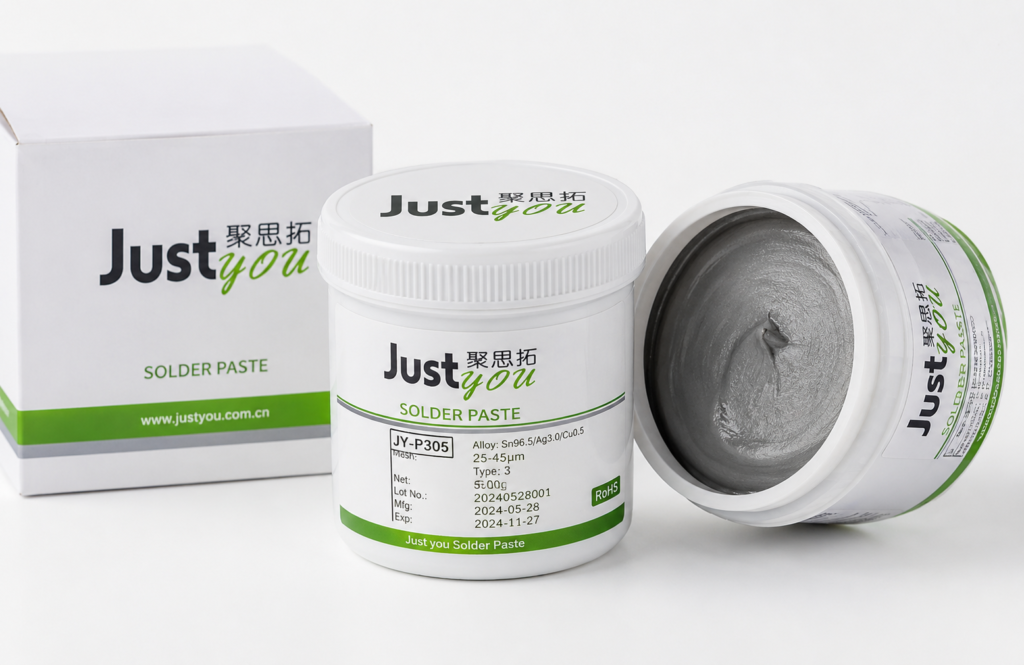
JustYou low-residue solder paste products are designed for excellent process stability and moisture resistance.
II. Screen Printing Process Optimization
1. Stencil Design Optimization
Stencil thickness directly affects solder paste volume and soldering reliability.
Recommended Thickness
Small Components (0201 / 0402)
- 0.10–0.12 mm thin stencil
Large Components (BGA / QFP)
- 0.15–0.18 mm stencil
Proper aperture design also reduces:
- Bridging
- Solder ball formation
- Voids
- Insufficient solder
For BGA pads, JustYou recommends:
- 0.05 mm inner offset
For QFN packages:
- 1:0.92 area ratio
Flow channels can also reduce solder accumulation risks.
2. Printing Parameter Control
Precise printing parameters ensure solder paste uniformity.
Pressure Control
Recommended pressure:
- 0.15–0.4 kg/cm²
For ultra-small 0201 components:
- Fine adjustment around 0.25 kg/cm²
Excessive pressure may cause:
- Stencil deformation
- Thin solder deposits
- Uneven printing
Printing Speed Optimization
Recommended settings:
- 25 mm/s for fine-pitch areas
- 50 mm/s for standard SMT areas
Lower speeds improve aperture filling consistency.
Squeegee Angle Control
Recommended angles:
Rubber Squeegee
- 45–50°
Metal Squeegee
- 50–60°
Proper angle adjustment improves solder paste release efficiency.
3. Real-Time SPI Monitoring
JustYou recommends using 3D SPI inspection systems to monitor:
- Solder paste thickness
- Volume consistency
- Alignment accuracy
Recommended tolerance:
- ±15 μm
Automatic alarms should stop production when parameters exceed limits.
Regular inspection every 2 hours helps identify:
- Bridging
- Insufficient solder
- Missing deposits
- Shape deformation
III. Reflow Soldering Temperature Control
1. Optimized Reflow Temperature Profile
A stable temperature curve is critical for reducing thermal shock.
Preheating Zone
Recommended ramp rate:
- 1.5–2°C/s
Target temperature:
- 150°C
This prevents sudden thermal stress inside components.
Soaking Zone
Recommended conditions:
- 150–200°C
- 60–90 seconds
This stage activates flux and removes oxidation.
Reflow Zone
Recommended peak temperature:
- 245°C ± 5°C
Duration:
- 30–60 seconds
This ensures complete solder melting while minimizing oxidation.
Cooling Zone
Recommended cooling rate:
- 3–4°C/s
Controlled cooling helps reduce:
- Internal stress
- Solder joint cracking
- Tin whisker formation
2. Nitrogen Reflow Protection
Nitrogen environments significantly reduce oxidation risks.
Recommended oxygen concentration:
- 500–1000 ppm
Nitrogen protection is especially effective for:
- Fine-pitch SMT
- High-density PCB assembly
- Mini LED packaging
- Semiconductor devices
3. Localized Heating and Cooling Control
For high-MSL components such as MSL-5a chips:
- Use local cooling fixtures
- Avoid sudden temperature spikes
- Apply gradient heating techniques
Temperature compensation of ±3°C can balance thermal expansion differences and reduce tombstoning.
IV. Environmental and Operational Standards
1. Workshop Environmental Control
Stable environmental conditions are essential for solder paste stability.
Recommended Conditions
Temperature:
- 20–26°C
Humidity:
- 40–60% RH
Dew point difference:
- ≤5°C
These conditions help prevent:
- Moisture absorption
- Solder paste drying
- Oxidation
Operators should wear anti-static dust-free garments to avoid contamination.
2. Proper Operational Procedures
Avoid Direct Hand Contact
Sweat contamination may cause:
- Corrosion
- Poor solderability
- Oxidation
Controlled Rework Process
Avoid excessive heat during rework.
Instead of:
- 500°C heat guns
Use:
- Low-temperature soldering
- Localized hot-air repair
Screw Tightening Sequence
Use diagonal tightening methods to minimize PCB mechanical stress.
V. Advanced SMT Technologies and Smart Monitoring
1. Fine-Pitch Soldering Technology
For ultra-small 01005 components:
JustYou recommends:
- Type 6 solder paste
- 0.03 mm printing thickness
- High-precision placement systems
This improves:
- Placement accuracy
- Solder consistency
- Process reliability
2. PoP (Package-on-Package) Assembly
Stepped stencil technology improves multilayer soldering quality.
Recommended design:
- Lower layer: 0.1 mm
- Upper layer: 0.15 mm
This ensures stable solder joints between stacked packages.
3. Intelligent Big Data Monitoring
Modern SMT lines increasingly use intelligent monitoring systems.
JustYou supports smart manufacturing solutions that collect real-time process data including:
- Temperature
- Pressure
- Printing speed
- SPI results
- X-ray inspection data
This allows early prediction of popcorn effect risks.
Smart Alarm Systems
Automated alarms can immediately stop production when systems detect:
- Delamination
- Insufficient solder
- Abnormal SPI readings
- X-ray defects
This significantly improves yield and reduces defective production.
Why Choose JustYou SMT Materials?
JustYou provides professional SMT solder paste solutions for advanced electronic manufacturing industries worldwide.
Our Advantages
- High-reliability solder paste
- Low-residue formulations
- Excellent printing performance
- Stable reflow characteristics
- Advanced SMT process support
- OEM & ODM capabilities
- Global export experience
Our products are widely used in:
- Automotive electronics
- Semiconductor packaging
- Mini LED production
- Industrial automation
- Consumer electronics
- Communication equipment
Conclusion
The popcorn effect is a complex issue involving moisture control, solder paste management, reflow temperature optimization, environmental stability, and intelligent manufacturing systems.
By implementing strict solder paste process control and advanced SMT management strategies, manufacturers can greatly reduce component failure risks and improve long-term product reliability.
JustYou continues to provide innovative SMT materials and technical solutions to support next-generation electronic manufacturing worldwide.